I'd definitely recommend this book by Keri Smith as a way to break out of your creative comfort zone.
Art
"Art is Theft" - Picasso
Sunday, 1 March 2015
February 2015: Wreck this Journal
Been experimenting with different materials recently and managed to make a pair of lungs out of squeezing ketchup and brown sauce onto the pages of Wreck this Journal and closing it.
I'd definitely recommend this book by Keri Smith as a way to break out of your creative comfort zone.
Saturday, 31 January 2015
Worlds within our Worlds January 2015
By Pyanek
Close ups of a sugar cube, foam and 'x' key on a keyboard. Captures the simple beauty in everyday surroundings. Why leave the comfort of your own home to make great artwork? Work with what you've got.
Watercolour Paintings by Maja Wronska
What distinguishes Wronska's watercolours is the way she emboldens the negative spaces with paint, such as the red between trees or the gaps in the flowers. She also controls the paint well for such an unpredictable medium.
Thursday, 1 January 2015
December 2014 Instantly Recognisable
Post Pop: East Meets West Exhibition - Saatchi Gallery

Until visiting this exhibition I had no real interest in Pop Art, but it was here that I managed to truly understand its purpose; to represent objects that are instantly recognisable, in this case to both Western and Eastern cultures.
The most significant piece for me had to be the sculpture and Lenin and Jesus holding hands with Micky Mouse.
At the forefront of the exhibition's Ideology section, it was so bold, imposing and darkly comic. It is a satirist's dream; of course these characters wouldn't get along like this, but they're all worshiped like Gods. Just by different people.
The room of all the flags in the world made out of human hair was also particularly special. Again highly satirical, it brought a sense of mocking, bathos and ordinariness to the human obsession with nationalism.
Other works include Banksy's graphited door, (painting on an object we all recognise), the controversial mechanical statues of praying Muslims, and the MacDonald's van with rude messages scribbled on it. These objects are so easily identifiable that me and my brother got told off for using the arcade games, which, though just an art installation, surprisingly worked!
It is fair to say that Pop Art is now an increasingly attractive medium for contemporary artists. In a homogeneous, digital internet age where images, icons and symbols are becoming identifiable to the whole world, reacting creatively to them isn't such a bad idea.
Until visiting this exhibition I had no real interest in Pop Art, but it was here that I managed to truly understand its purpose; to represent objects that are instantly recognisable, in this case to both Western and Eastern cultures.
The most significant piece for me had to be the sculpture and Lenin and Jesus holding hands with Micky Mouse.
At the forefront of the exhibition's Ideology section, it was so bold, imposing and darkly comic. It is a satirist's dream; of course these characters wouldn't get along like this, but they're all worshiped like Gods. Just by different people.
The room of all the flags in the world made out of human hair was also particularly special. Again highly satirical, it brought a sense of mocking, bathos and ordinariness to the human obsession with nationalism.
Other works include Banksy's graphited door, (painting on an object we all recognise), the controversial mechanical statues of praying Muslims, and the MacDonald's van with rude messages scribbled on it. These objects are so easily identifiable that me and my brother got told off for using the arcade games, which, though just an art installation, surprisingly worked!
It is fair to say that Pop Art is now an increasingly attractive medium for contemporary artists. In a homogeneous, digital internet age where images, icons and symbols are becoming identifiable to the whole world, reacting creatively to them isn't such a bad idea.
November 2014 No Preconceptions
Rembrandt Exhibition - National Gallery

After wandering through the dark rooms of this exhibition, I got the sense of a painter who knew how to convey drama in his paintings.
The first room shows us his self-scrutinising portraits. Subdued and achingly honest, they represent his decaying and aging over time.
I saw how he played with light; manipulating the smooth transition from black ink to white paper, whilst unifying and enhancing dark and light areas for drama and symbolism. His work Adoration of the Shepards showed how he used light to draw the eye's attention to the central figure.
His experimental approaches to traditional tools and techniques meant he wasn't afraid about his work going wrong. This is evident in his use of the palette knife to apply paint or scratching with the paint brush, his strokes ranging from thin paint washes to dense, sculptural impasto.
I liked how in his observation of everyday life he had no preconceptions of beauty/ugliness, happily chooses subjects with peculiarities, randomness, defects, anomalies and ordinariness.
Intimacy is another aspect of his work, particularly in the painting of An Old woman Reading- Her face illuminated, it invites access for the curious viewer.
As the exhibition drew to a close I saw the necessity in his paintings of weighing strong passions and sentiments against each other. This was clear in his reconciliation paintings; situations before or after climactic, intense or trans-formative climaxes in a story. In this light, you could almost argue that Rembrandt was an early storyboard artist.
Anselm Kiefer Exhibition - The Royal Academy
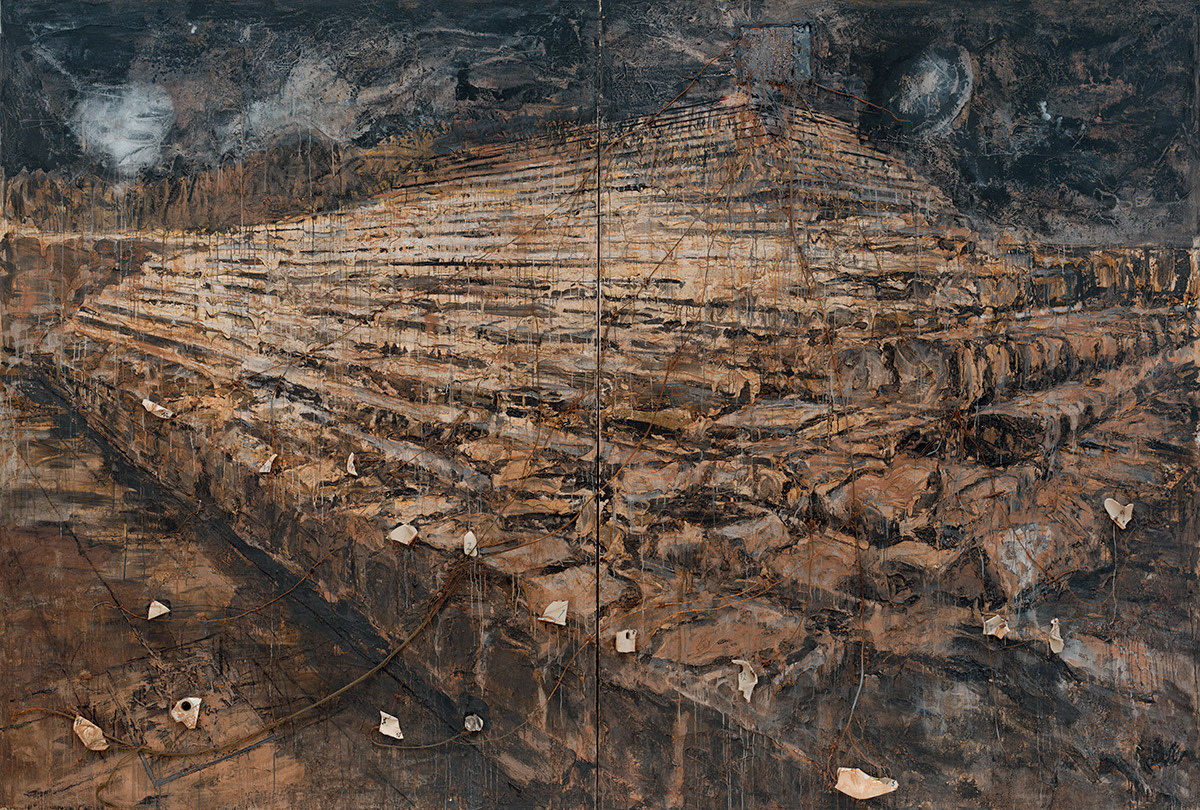
This is the piece of work I remember most from the Kiefer exhibition, perhaps since it has such an interesting composition. The eyes are led on an upward, diagonal journey to the top of the pyramid along wire and fragments from a toilet. As part of the ethos of all his works, like Rembrandt, Kiefer imposes no heirarchy or preconceptions on his materials - here, he creates a mystical world using ordinary, mundane objects. In this way, he was also trying to create a connection between ancient and modern worlds. His clay tablets, for example, showed what he believed to be the "secret connection between writing and building."
Other memorable works included the Painter's studio, in which he painted over photos and depictions of desolate landscapes with very high/low vanishing points.
To conclude, I'd like to list the fantastic array or materials he used;
Burnt books, rusted lead metal, sticks, wheat, burlap saccing, oil, acrylic, emulsion, straw, shellac, scorch marks, clay, ash, earth, dried sunflower, sand, ink, and I'm sure many more...
After wandering through the dark rooms of this exhibition, I got the sense of a painter who knew how to convey drama in his paintings.
The first room shows us his self-scrutinising portraits. Subdued and achingly honest, they represent his decaying and aging over time.
I saw how he played with light; manipulating the smooth transition from black ink to white paper, whilst unifying and enhancing dark and light areas for drama and symbolism. His work Adoration of the Shepards showed how he used light to draw the eye's attention to the central figure.
His experimental approaches to traditional tools and techniques meant he wasn't afraid about his work going wrong. This is evident in his use of the palette knife to apply paint or scratching with the paint brush, his strokes ranging from thin paint washes to dense, sculptural impasto.
I liked how in his observation of everyday life he had no preconceptions of beauty/ugliness, happily chooses subjects with peculiarities, randomness, defects, anomalies and ordinariness.
Intimacy is another aspect of his work, particularly in the painting of An Old woman Reading- Her face illuminated, it invites access for the curious viewer.
As the exhibition drew to a close I saw the necessity in his paintings of weighing strong passions and sentiments against each other. This was clear in his reconciliation paintings; situations before or after climactic, intense or trans-formative climaxes in a story. In this light, you could almost argue that Rembrandt was an early storyboard artist.
Anselm Kiefer Exhibition - The Royal Academy

This is the piece of work I remember most from the Kiefer exhibition, perhaps since it has such an interesting composition. The eyes are led on an upward, diagonal journey to the top of the pyramid along wire and fragments from a toilet. As part of the ethos of all his works, like Rembrandt, Kiefer imposes no heirarchy or preconceptions on his materials - here, he creates a mystical world using ordinary, mundane objects. In this way, he was also trying to create a connection between ancient and modern worlds. His clay tablets, for example, showed what he believed to be the "secret connection between writing and building."
Other memorable works included the Painter's studio, in which he painted over photos and depictions of desolate landscapes with very high/low vanishing points.
To conclude, I'd like to list the fantastic array or materials he used;
Burnt books, rusted lead metal, sticks, wheat, burlap saccing, oil, acrylic, emulsion, straw, shellac, scorch marks, clay, ash, earth, dried sunflower, sand, ink, and I'm sure many more...
Thursday, 18 December 2014
Artistic Inspirations
Miro
Miro was a sculptor, painter and ceramicist from Barcelona. His work has been interpreted as Surrealism, a sandbox for the subconscious mind, and re-creation of the childlike. In numerous interviews dating from the 1930s onwards, MirĂ³ expressed contempt for conventional painting methods as a way of supporting bourgeois society, and famously declared an "assassination of painting" in favour of upsetting the visual elements of established painting.
Kiefer
In his entire body of work, Kiefer argues with the past and addresses taboo and controversial issues from recent history. He is known for works which incorporate a variety of earthly materials such as straw, ash, clay, lead, shellac, then adding to them with thick layers of emulsion and acrylic paint.
Patrick Heron
Jenny Saville
Jenny Saville is a contemporary British Figure Painter. She draws inspiration and painting techniques from traditional figure painters and applies it to modern subjects such as women undergoing childbirth. My interest in her work came from the layering of materials such a paint or pencil to create a sense of movement and vibrancy in her figures. This could be described as an attempt to animate them and make them exist in the present time.
Picasso - Bull's Head
A Bull's Head made out of the saddle and handlebar of a bicycle. Picasso was mad about bullfighting, even naming himself after a 'picador,' so what better to show his passion than by making use of everyday objects around him.
Before throwing away your next cereal box or can of beans, see if you can turn it into something you care about...
Rembrandt
A lesson on how to convey emotion through figure paintings and etchings. Known for constantly re-working them.
Gaudi
Imbues his architecture with fantasy and natural form.
Henry Moore
Works on abstracting the figure and its place in the landscape. His drawings informed his sculpture and in themselves explored light and composition.
Barbara Hepworth
Abstracts and simplifies forms into new compositions.
Alberto Burri
Gets the essence of a figure rather than a direct replica.
Anthony Gormley
Explores the human form in relation to space. I particularly like the fluidity of his ink experiments.

Stanley Spencer
Combining heightened religious narratives and imagery among the personal, ordinary English village where he lived.

Dean Tavoularis
Explores the human form in relation to space. I particularly like the fluidity of his ink experiments.
Stanley Spencer
Combining heightened religious narratives and imagery among the personal, ordinary English village where he lived.
Dean Tavoularis
A Hollywood Storyboard artist known for his work on The Godfather films, Apocalypse Now, The Brink's Job, One from the Heart and Bonnie and Clyde.
I like the use of colour and sketchy nature of his drawings.
http://www.cinematheque.fr/uk/museum-and-collections/actualite-collections/dons-acquisitions/dessins-alex-tavoularis-pour-coppola.html

Subscribe to:
Posts (Atom)
