Rembrandt Exhibition - National Gallery

After wandering through the dark rooms of this exhibition, I got the sense of a painter who knew how to convey drama in his paintings.
The first room shows us his self-scrutinising portraits. Subdued and achingly honest, they represent his decaying and aging over time.
I saw how he played with light; manipulating the smooth transition from black ink to white paper, whilst unifying and enhancing dark and light areas for drama and symbolism. His work
Adoration of the Shepards showed how he used light to draw the eye's attention to the central figure.
His experimental approaches to traditional tools and techniques meant he wasn't afraid about his work going wrong. This is evident in his use of the palette knife to apply paint or scratching with the paint brush, his strokes ranging from thin paint washes to dense, sculptural impasto.
I liked how in his observation of everyday life he had no preconceptions of beauty/ugliness, happily chooses subjects with peculiarities, randomness, defects, anomalies and ordinariness.
Intimacy is another aspect of his work, particularly in the painting of An Old woman Reading- Her face illuminated, it invites access for the curious viewer.
As the exhibition drew to a close I saw the necessity in his paintings of weighing strong passions and sentiments against each other. This was clear in his reconciliation paintings; situations before or after climactic, intense or trans-formative climaxes in a story. In this light, you could almost argue that Rembrandt was an early storyboard artist.
Anselm Kiefer Exhibition - The Royal Academy
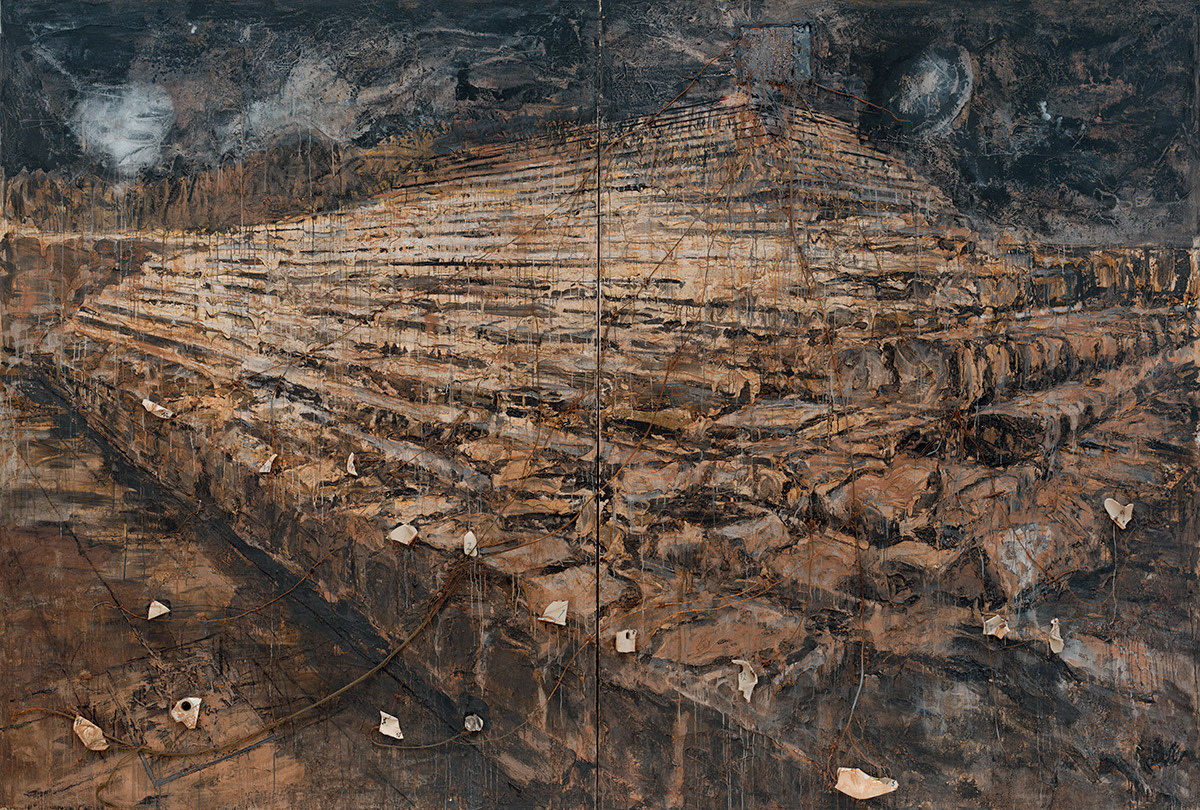
This is the piece of work I remember most from the Kiefer exhibition, perhaps since it has such an interesting composition. The eyes are led on an upward, diagonal journey to the top of the pyramid along wire and fragments from a toilet. As part of the ethos of all his works, like Rembrandt, Kiefer imposes no heirarchy or preconceptions on his materials - here, he creates a mystical world using ordinary, mundane objects. In this way, he was also trying to create a connection between ancient and modern worlds. His clay tablets, for example, showed what he believed to be the "secret connection between writing and building."
Other memorable works included the Painter's studio, in which he painted over photos and depictions of desolate landscapes with very high/low vanishing points.
To conclude, I'd like to list the fantastic array or materials he used;
Burnt books, rusted lead metal, sticks, wheat, burlap saccing, oil, acrylic, emulsion, straw, shellac, scorch marks, clay, ash, earth, dried sunflower, sand, ink, and I'm sure many more...
 Worlds Within our Worlds


